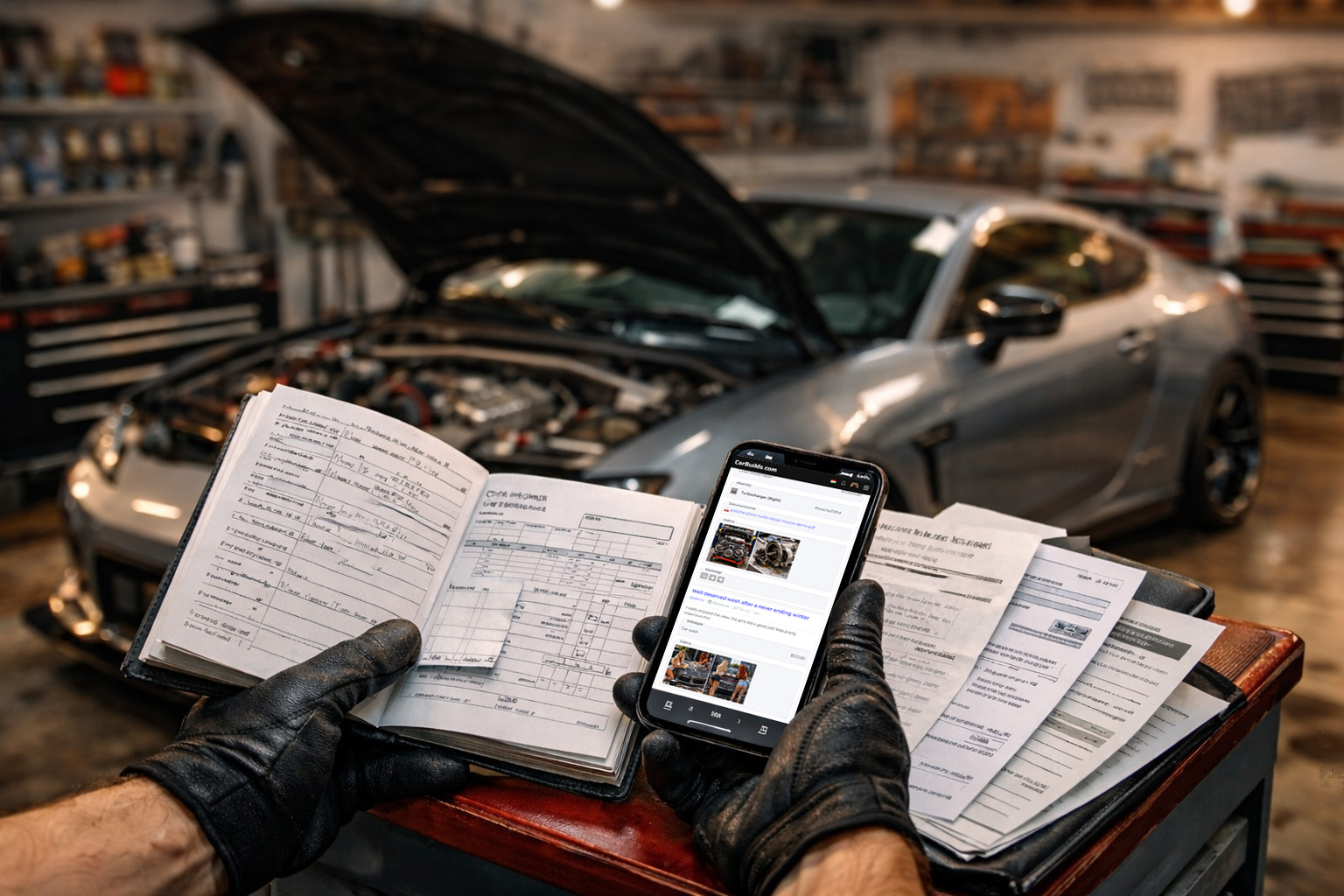
When people talk about a car’s value, the conversation almost always revolves around the usual suspects: mileage, condition, specs, maybe a few tasteful mods. And while those things absolutely matter, they’re only part of the picture—especially in the enthusiast world.
If you’ve ever browsed listings long enough, you’ve probably noticed something interesting. Two nearly identical cars can be listed side by side, yet one sells quickly at a higher price, while the other struggles to get attention. The difference isn’t always visible at first glance, but it becomes obvious the moment you start digging deeper.
It comes down to one thing: how well the car’s story is documented.
A Well-Told Story Builds Trust
Buyers today are more cautious than ever. Anyone can write “well maintained” in a listing, but those words have lost their meaning over time. What people are really looking for is proof—something tangible that shows how the car has been treated throughout its life.
This is where a detailed timeline becomes incredibly powerful. When every oil change, service, and repair is recorded properly, it creates a clear picture of consistency and care. Instead of guessing how the car was treated, potential buyers can actually see it.
That shift—from assumption to certainty—is what builds trust. And trust is what makes someone willing to pay more.
Modifications Mean Nothing Without Context
In enthusiast culture, modifications are a huge part of a car’s identity. But from a buyer’s perspective, mods can either increase value or raise red flags—it all depends on how they’re presented.
A list of parts in a description doesn’t say much. Buyers immediately start questioning things: Who installed them? When were they done? Were they done properly? Are there any supporting details?
Now compare that to a documented build timeline. Each modification is tied to a specific moment, complete with photos, notes, and parts used. Suddenly, the same upgrades carry a completely different weight. They’re no longer just “mods”—they become part of a transparent, well-thought-out build process.
That level of detail doesn’t just look good; it reassures buyers that the car hasn’t been thrown together randomly.
Consistent Maintenance Is Only Valuable If It’s Visible
Most owners do take care of their cars. The problem is that very few actually track that care in a structured way. From a buyer’s point of view, undocumented maintenance might as well not exist.
When you maintain a proper record of routine services—oil changes, brake work, fluid replacements—it creates a pattern over time. That pattern shows discipline and attention to detail. More importantly, it removes doubt.
Instead of relying on memory or scattered receipts, everything is in one place, easy to follow and impossible to misinterpret. This consistency is one of the strongest signals of a well-kept car, and it directly impacts how buyers perceive its value.
Staying on Top of Maintenance Without the Guesswork
Of course, keeping such a detailed history requires consistency, and that’s where most people fall off. It’s not because they don’t care—it’s because life gets in the way.
It’s easy to lose track of service intervals or postpone small maintenance tasks until they become bigger issues. Having a system that reminds you about upcoming and overdue maintenance can make a huge difference, not just for the car itself, but for the quality of its history.
When nothing gets missed, your timeline stays complete. And when your timeline is complete, your car becomes significantly more attractive to future buyers.
Showing the History Changes Everything
When it’s time to sell, most listings rely heavily on text descriptions and a handful of photos. But a documented timeline allows you to present your car in a completely different way.
Instead of asking buyers to trust your words, you can show them everything. Individual events can be shared, or the entire build history can be presented as a single, continuous story. This can even be embedded directly into your listing, giving potential buyers instant access to the car’s full background.
At that point, your listing stops being just another ad—it becomes an experience. Buyers spend more time on it, engage with it more deeply, and build confidence before they even reach out.
Value That Doesn’t Disappear After the Sale
One of the biggest limitations of traditional ownership is that all history is effectively reset when the car changes hands. The new owner starts from zero, regardless of how well the car was previously maintained.
But when the full history is transferable, that changes completely. Every service, every modification, every detail continues to live with the car, even after it’s sold.
This doesn’t just benefit the next owner—it reinforces the value of the car itself. Over time, the vehicle builds a continuous, verified story that makes it stand out more and more with each owner.
Final Thoughts
Increasing your car’s value isn’t always about spending more money or adding more parts. In many cases, it’s about making the effort you’ve already put in visible and easy to understand.
A well-documented car tells a story that buyers can trust. It removes uncertainty, highlights care, and sets your vehicle apart in a crowded market.
And in a space where most listings still rely on vague descriptions and incomplete information, that alone can be enough to push your car into a higher tier—and justify a higher price.